
Theme Boundaries and Visual Direction
A collection board can look coherent while the same direction becomes unclear on a garment, listing frame, or production handoff. Apparel theme development needs a reviewable boundary: what belongs in the graphic set, what stays outside it, which variables change the read, and which questions remain open.
The useful decision is not simply which design looks better. It is which visual route the team can explain, compare, revise, and carry into the next review stage. A simulated mockup can suggest direction, but it cannot confirm provider requirements, physical color, manufacturing results, rights permission, marketplace acceptance, or sales performance.
More specific pages
These pages continue the topic in smaller, more specific directions.
What an Apparel Theme Boundary Brief Decides
An apparel theme boundary brief defines the limits of a collection before individual graphics become difficult to compare. It gives the team a shared reference for motifs, garment tone, placement, scale, colorway, exclusions, and current asset status.
A practical brief usually records:
- Collection theme and intended garment context
- Anchor, supporting, texture, connector, and exclusion motifs
- Reference types, source records, and adaptation status
- Garment tones and artwork colorways
- Placement routes and intended scale
- Thumbnail and listing-frame observations
- Exclusions and unresolved identifier questions
- Provider-specific checks still required
- Rights-review questions and responsible reviewers
- Current evidence state for each asset
The brief sits between broad visual intent and the detailed records needed for production, sampling, listing review, or external confirmation. It is not a technical production file or a rights clearance record.
Separate the states of the work
Status labels prevent a concept preview from being mistaken for an approved or produced asset. Record each open question separately instead of hiding it under a general status.
| Status | What it describes | What remains open |
|---|---|---|
| Intended | A direction the team wants to explore | Motif fit, scale, placement, and reference review |
| Simulated | A concept shown in a garment or listing frame | Physical color, print behavior, and provider fit |
| Provider-checked | Artwork compared with a current product template | Manufacturing result and final product inspection |
| Rights review pending | A source, identifier, attribution, or permission question has been recorded | Review by the responsible party |
| Sampled | A physical sample exists for inspection | Revision, approval, or production decision |
| Approved | The responsible team has recorded an approval | Production and marketplace processes may still apply |
| Produced | The asset has reached the intended production stage | Any remaining quality or listing checks |
Define Motif Consistency Before Choosing Variations
Motif consistency does not require every garment to repeat the same image. It requires the graphic set to share a recognizable visual relationship.
A collection may connect through repeated shapes or line qualities, a controlled palette, similar detail levels, related subject matter, consistent composition rules, shared placement logic, or a recurring relationship between positive and negative space. Research on printed textile design also groups concepts through color, theme, and technique direction before connecting them with later decisions about palette, garment context, and print development.
The working distinction is useful: a theme is a direction system, not merely a folder of similar images.
Compare motifs by function
Instead of recording only whether a motif feels attractive, identify the role it performs in the graphic set.
| Motif role | Review focus | Possible consequence |
|---|---|---|
| Anchor motif | Carries the collection’s main visual identity | May become too dominant across several placements |
| Supporting motif | Reinforces the anchor without competing with it | May disappear at thumbnail size |
| Texture motif | Adds surface rhythm or depth | May lose clarity when reduced |
| Connector motif | Links separate graphics or colorways | May feel decorative without repeated logic |
| Exclusion motif | Marks an element outside the theme | Helps prevent late additions from weakening the set |
A motif that works as a large back graphic may fail as a small pocket mark. That is not necessarily a contradiction. It shows that the motif has a placement-specific role.
Record the motif rule
Use one or two observable sentences to describe the collection’s motif rule. For example:
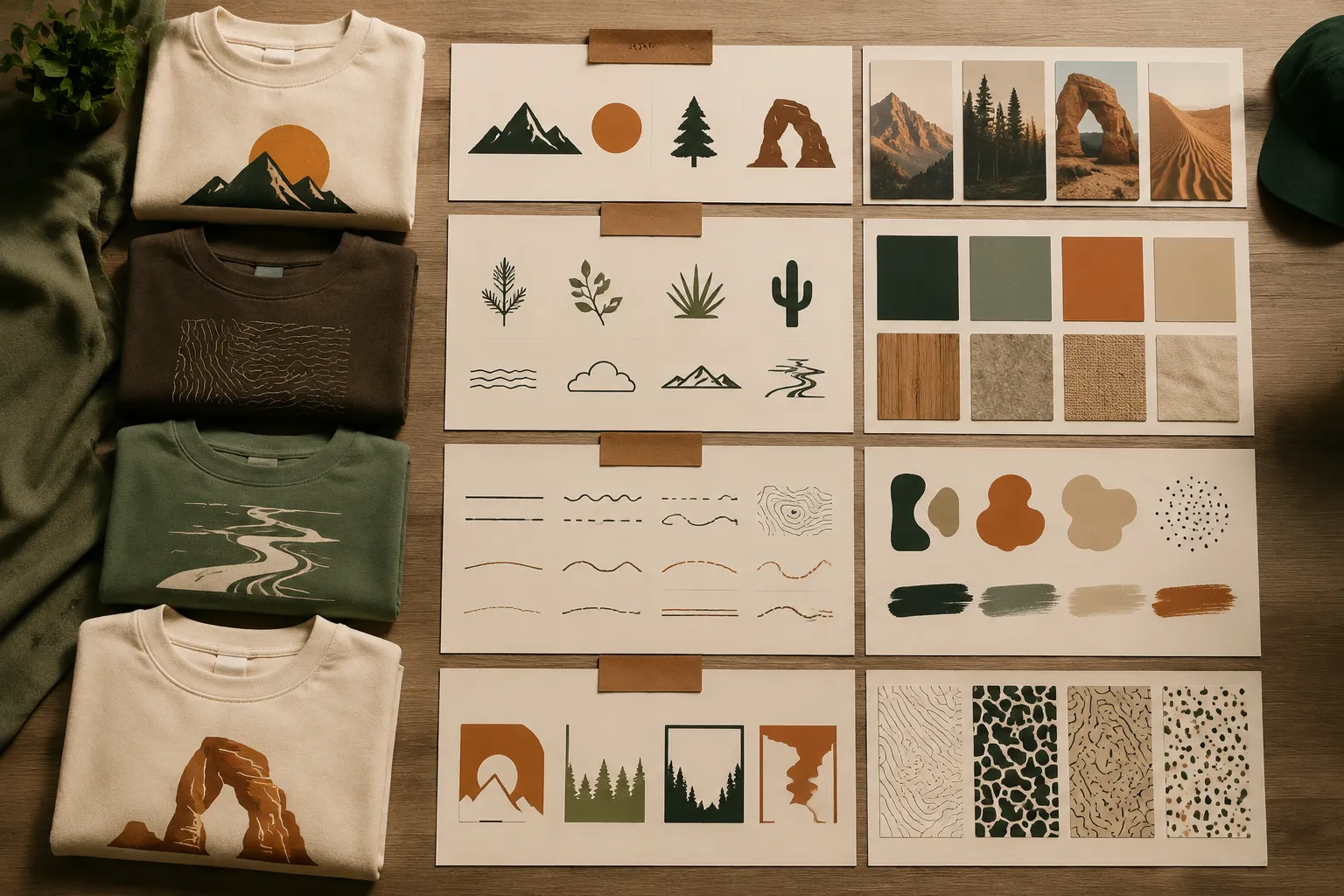
The graphic set uses irregular botanical outlines, limited interior detail, and a quiet secondary mark. Dense photographic imagery, realistic brand identifiers, and unrelated geometric symbols remain outside the theme.
This is more reviewable than a brief built only around words such as “natural,” “modern,” or “bold.” The team can use the rule to retain, revise, or reject later artwork.
Separate References From Exclusions
References explain the intended direction. Exclusions keep that direction from becoming so broad that every new graphic appears to fit.
A reference may describe a compositional relationship, historical or visual period, line treatment, texture, garment placement, color relationship, motif type, campaign mood, or product presentation style. An exclusion should state what the team will avoid and why.
Useful exclusion criteria include unrelated subject matter, excessive detail, conflicting line quality, garment tones that weaken contrast, placements that break the collection rhythm, recognizable identifiers requiring separate review, or sources whose attribution or permission remains unclear.
A familiar brand element, logo, name, or original artwork does not become available merely because it appears on a mood board. General information from the USPTO and the U.S. Copyright Office can frame a review, but it does not resolve a particular ownership or permission question.
Build a source record
Keep the visual reference and its review status in separate fields.
| Source-record field | Example entry |
|---|---|
| Reference label | High-contrast botanical outline |
| Source location | Book, photograph, archive, supplied image, or internal sketch |
| Intended use | Shape reference only |
| Adaptation status | To be redrawn |
| Identifier present | No, yes, or unclear |
| Attribution detail | Recorded, pending, or not applicable |
| Permission question | Open or resolved by the responsible reviewer |
| Collection role | Anchor motif or supporting motif |
| Review status | Reference only |
The record should distinguish inspiration, adaptation, attribution, and permission questions. Documentation alone does not establish that a reference can be used.
Compare Garment Tone, Colorway, and Placement Together
Garment-tone contrast changes how a motif reads, how much detail remains visible, and whether separate products still look like one collection. It should be reviewed with artwork tone, placement size, and viewing context rather than as an isolated color choice.
Compare colorways against the same variables:
- Garment tone and artwork tone
- Contrast between artwork and fabric
- Detail density and motif scale
- Placement and intended viewing distance
- Listing-frame crop
- Relationship to other garments in the set
Light artwork may read clearly on a dark garment but lose contrast on a pale garment. A detailed motif may remain legible in a large back placement while becoming indistinct on a small front placement. Printed textile research also identifies motif scale, spacing, end use, and equipment as factors that can affect design development. These are process considerations, not universal current specifications.
Use a shared comparison frame
Compare routes against the same garment, audience, crop, and launch context. A direction should not appear stronger simply because it received a more favorable presentation frame.
| Route | Strength to inspect | Dependency |
|---|---|---|
| High contrast | Clear separation between garment and artwork | May feel too sharp for a restrained theme |
| Low contrast | Quieter, more integrated appearance | Fine detail may disappear |
| Tonal contrast | Narrow palette relationship | Needs careful scale and thumbnail checking |
The appropriate route depends on visual intent, garment range, listing context, and later production checks. Record the reason for the choice rather than labeling one treatment objectively superior.
Review Placement as a Collection System
Front, back, sleeve, pocket, and all-over concepts do not carry the same visual weight. Placement changes how a graphic set behaves across products, especially when motifs repeat at different scales.
A placement pass should check:
- Whether the motif remains recognizable at the intended size
- Whether the placement supports the garment’s visible area
- Whether the graphic balances the rest of the collection
- Whether it repeats a collection rule or introduces a new one
- Whether it approaches the relevant print area
- Whether the listing frame shows enough of the garment
- Whether the design becomes crowded, distorted, or isolated
Placement logic and listing presentation are related but separate decisions. A listing frame shows how a concept might appear in a product or campaign context. It does not confirm that the artwork fits a current provider template, print area, file requirement, or production input.
Keep the theme board, placement board, simulated mockup, listing frame, provider-checked artwork, physical sample, and final production record distinct in the brief. A convincing mockup may still hide an unsuitable crop, incorrect scale, or unresolved file requirement.
Check Thumbnail Readability Early
Thumbnail readability tests whether the main visual idea survives reduction. The check is useful for collection grids, listing frames, campaign previews, and other small presentation contexts.
Record whether the anchor motif remains recognizable, the main colors separate, the silhouette stays clear, negative space remains visible, the graphic merges with the garment, products remain distinct, and placement is still apparent.
| Observation | Consequence | Revision action |
|---|---|---|
| Anchor motif disappears | Collection identity weakens in the listing grid | Increase scale or simplify internal detail |
| Artwork merges with garment tone | Placement becomes difficult to read | Compare another colorway or garment tone |
| Several graphics look identical | The set loses useful variation | Assign clearer motif roles |
| Small mark becomes visual noise | Pocket or sleeve placement feels crowded | Reduce detail or remove the mark |
| Back graphic dominates every frame | The product range feels repetitive | Introduce a quieter supporting placement |
This is an observed presentation check, not sales evidence. It can guide revision without predicting demand, ranking, conversion, or sales.
Use a Review Sequence That Leaves a Record
The apparel theme review sequence should move from broad direction to visible comparison, then to external confirmation points.
- State the collection intent.
Write one sentence describing the visual direction and another describing the intended garment context. Replace broad labels such as “urban,” “playful,” or “premium” with observable criteria.
- Group the motifs.
Separate anchor, supporting, texture, connector, and exclusion motifs. Remove elements that cannot be assigned a clear role.
- Compare the same garment context.
Place candidate graphics against the same garment tone, placement, crop, and viewing scale.
- Test scale and thumbnail behavior.
Inspect the graphic at intended placement size and listing-grid size. Record what disappears, merges, or dominates.
- Review references and exclusions.
Identify sources, identifiers, original artwork, attribution details, and unresolved permission questions. Keep rights review separate from visual preference.
- Mark the production checkpoint.
Compare the artwork with the current provider product template and relevant print-area information. A provider-specific document supports that checkpoint only for the applicable provider and product.
- Choose the next evidence state.
The concept may need another simulated comparison, provider confirmation, physical sampling, direct clarification from a manufacturer or contractor, rights review, a revised source record, or a separate listing review.
- Record the decision.
For every retained or rejected route, record the decision, reason, evidence state, open dependency, responsible reviewer, and next review point.
The handoff should make unresolved questions visible rather than making the brief appear complete.
When a Mockup Stops Being Enough
A simulated mockup can support visual questions about motif fit, placement balance, thumbnail readability, garment-tone contrast, and collection coherence. It becomes insufficient when the question depends on a physical result, current external requirement, rights determination, or marketplace decision.
Move from concept preview to a provider check when artwork must be fitted to a current product template. Move to physical sampling when color, fabric interaction, placement, scale, or produced appearance matters. Move to a responsible rights review when identifiers, attribution, source ownership, or permission remain unresolved.
Provider requirements, sampling results, rights status, marketplace rules, and commercial performance are separate confirmation points. A theme brief can carry those dependencies forward; it cannot settle them by itself.
Common Concept Mix-Ups
- Theme direction versus artwork approval
- A theme brief establishes visual intent and exclusions. It does not establish that every artwork file is ready for production.
- Reference use versus rights permission
- A reference may explain visual direction without becoming an asset for commercial use. Record the source and the open question separately.
- Mockup quality versus printed result
- A clean simulated mockup may improve presentation while remaining unconfirmed as a physical garment. Treat it as a concept preview.
- Collection consistency versus repetition
- A coordinated graphic set needs shared rules, but every garment does not need the same motif, size, or placement.
- Provider guidance versus universal specification
- A provider document can support a provider-specific checkpoint. It cannot establish current requirements for every product, platform, or production method.
- Thumbnail clarity versus market performance
- A graphic that reads clearly in a listing frame has passed a presentation check. That observation does not establish demand, ranking, conversion, or sales.
A Compact Brief Structure for Team Handoff
Use this structure when the collection needs a practical review record:
- Theme statement: Describe the visual direction in observable terms.
- Motif system: List anchor, supporting, texture, connector, and exclusion motifs.
- Reference register: Record source, intended use, adaptation status, attribution details, and unresolved permission questions.
- Garment context: Record garment tone, product range, placement options, and intended viewing scale.
- Colorway comparison: Show artwork and garment combinations using the same presentation frame.
- Thumbnail check: Record what reads, disappears, merges, or dominates.
- Mockup status: Label each image as concept preview, simulated mockup, provider-checked, sampled, approved, or produced.
- Provider checkpoint: Attach the current product template or record details requiring direct confirmation.
- Rights-review checkpoint: Separate visual reference decisions from ownership, permission, identifier, and attribution questions.
- Decision log: Record retained routes, rejected routes, reasons, unresolved questions, and next owners.
This structure keeps the visual brief useful without making it a substitute for technical, rights, sampling, marketplace, or final design review.
The Handoff to the Next Collection Stage
A theme brief can move onward when the team can explain the retained visual route, identify excluded elements, compare garment tone and placement choices, and locate every unresolved question.
The next stage should receive the motif system, reference record, colorway comparisons, placement decisions, mockup status, provider checkpoint, rights-review questions, and decision log rather than a mood board alone.
Technical or sampling work can then confirm details the theme brief cannot establish. Listing and campaign work can use the recorded visual direction while keeping simulated presentation separate from produced evidence. Open rights and marketplace questions should travel as explicit dependencies into the responsible review.
Sources
- Printful Design Maker and File Guidelines
- USPTO Trademark Basics
- U.S. Copyright Office: Copyright Basics
- The role of standardized technical packages in ensuring consistency and accuracy in apparel product development
- An Integrated Printed Textile Design and Apparel Product Development Process
- Toward a Model of Retail Product Development: A Case Study Analysis