
Apparel Theme Boundary Brief: Motifs, References, and Exclusions

When a team cannot explain what each reference contributes or what must stay out, it has an inspiration pile. It does not yet have a decision-ready apparel theme brief.
A usable brief names the motif family, permitted attributes, explicit exclusions, garment context, and unresolved questions. It guides interpretation without prescribing every graphic detail. Rights, provider, production, and marketplace status remain separate confirmation points.
What the Brief Must Decide
An apparel theme brief sits between broad visual research and technical production records. It defines the creative territory shared by a graphic set.
- Theme direction: the central visual idea in plain language.
- Motif family: recurring symbols, shapes, image treatments, textures, or compositional devices.
- Permitted attributes: selected qualities that may carry forward from each reference.
- Excluded attributes: source-specific elements that should not be reproduced or developed.
- Fixed elements: decisions that should remain stable across the collection.
- Flexible elements: areas open to garment-specific interpretation.
- Garment context: intended silhouettes, garment tones, placements, and audience setting.
- Evidence state: intended, observed, simulated, sampled, approved, produced, or unconfirmed.
- Open questions: matters requiring rights, provider, production, or marketplace confirmation.
- Handoff owner: the person responsible for resolving each open item.
This brief is not a production specification. It also does not establish rights permission, print behavior, provider acceptance, or likely sales.
Mood Board Versus Theme Brief
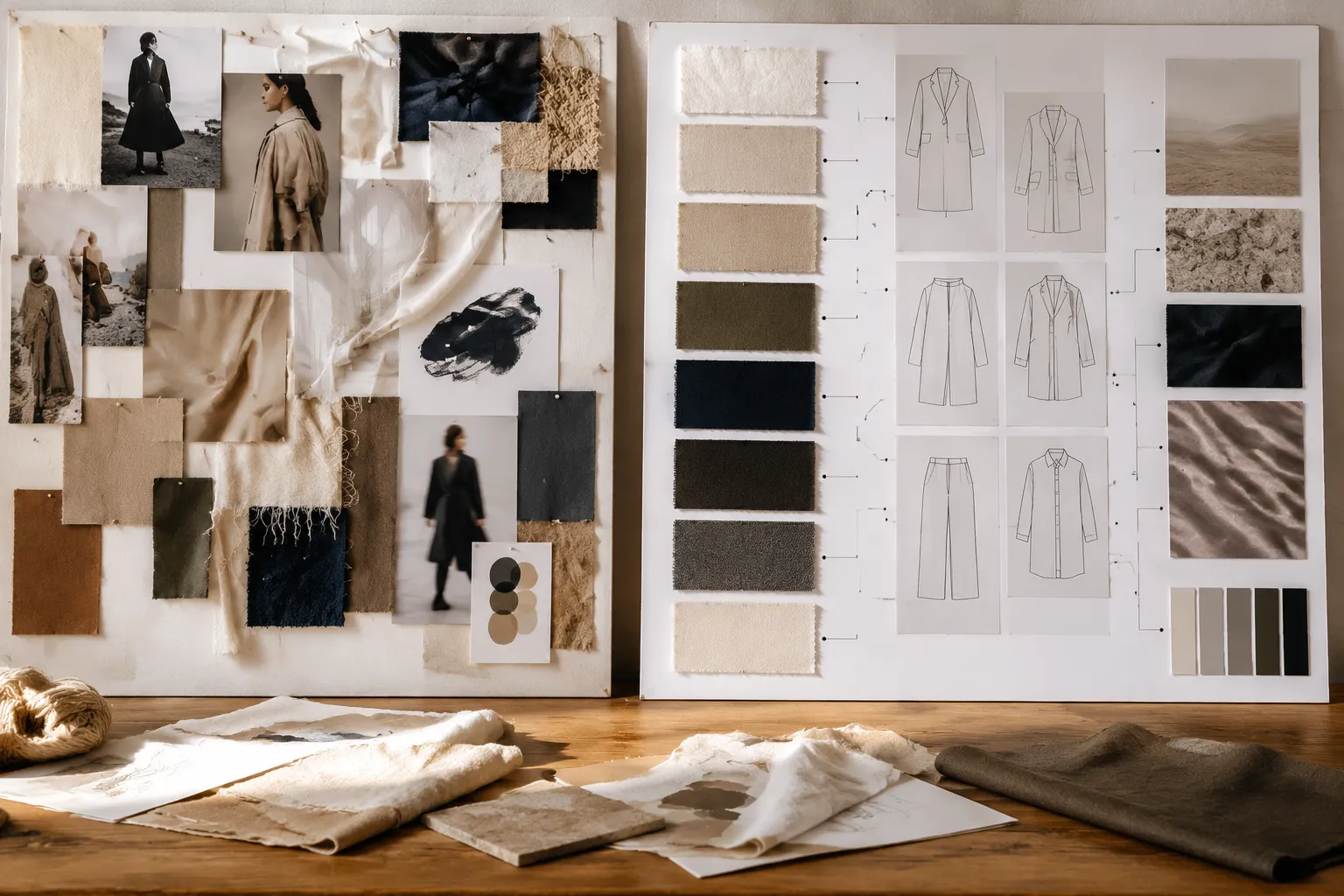
A mood board shows visual territory through photographs, garments, textures, colors, typography, or sketches. The theme brief extracts usable decisions from that material.
| Asset | Primary job | Question answered |
|---|---|---|
| Mood board | Show inspiration and atmosphere | What visual territory is relevant? |
| Apparel theme brief | Define creative boundaries | What may carry forward, and what stays out? |
| Simulated mockup | Preview a graphic in context | How might it read on the intended garment? |
| Production record | Describe execution requirements | What must be confirmed for manufacture? |
| Physical sample | Expose material and process behavior | What is observable on the produced sample? |
A reference may be present only for its lighting, proportion, texture, or color relationship. Without annotation, another reviewer may mistake it for a reproduction target. Separate the source from the attributes selected for use.
Annotate Every Meaningful Reference
Do not let a screenshot carry the entire explanation. Give each meaningful reference a concise source and decision record.
- Source record: original file, creator or publication where known, retrieval date, and internal location.
- Asset type: photograph, garment, artwork, architecture, natural form, typography, or another relevant category.
- Intended takeaway: the single reason the reference belongs in the brief.
- Permitted attributes: selected qualities such as proportion, texture, rhythm, silhouette, or placement logic.
- Excluded attributes: exact wording, recognizable marks, character likenesses, or distinctive arrangements not being carried forward.
- Garment relationship: the tone, silhouette, print area, and placement under consideration.
- Evidence state: what has been observed and what remains intended, simulated, or unconfirmed.
- Open question and owner: the unresolved issue and the role responsible for confirming it.
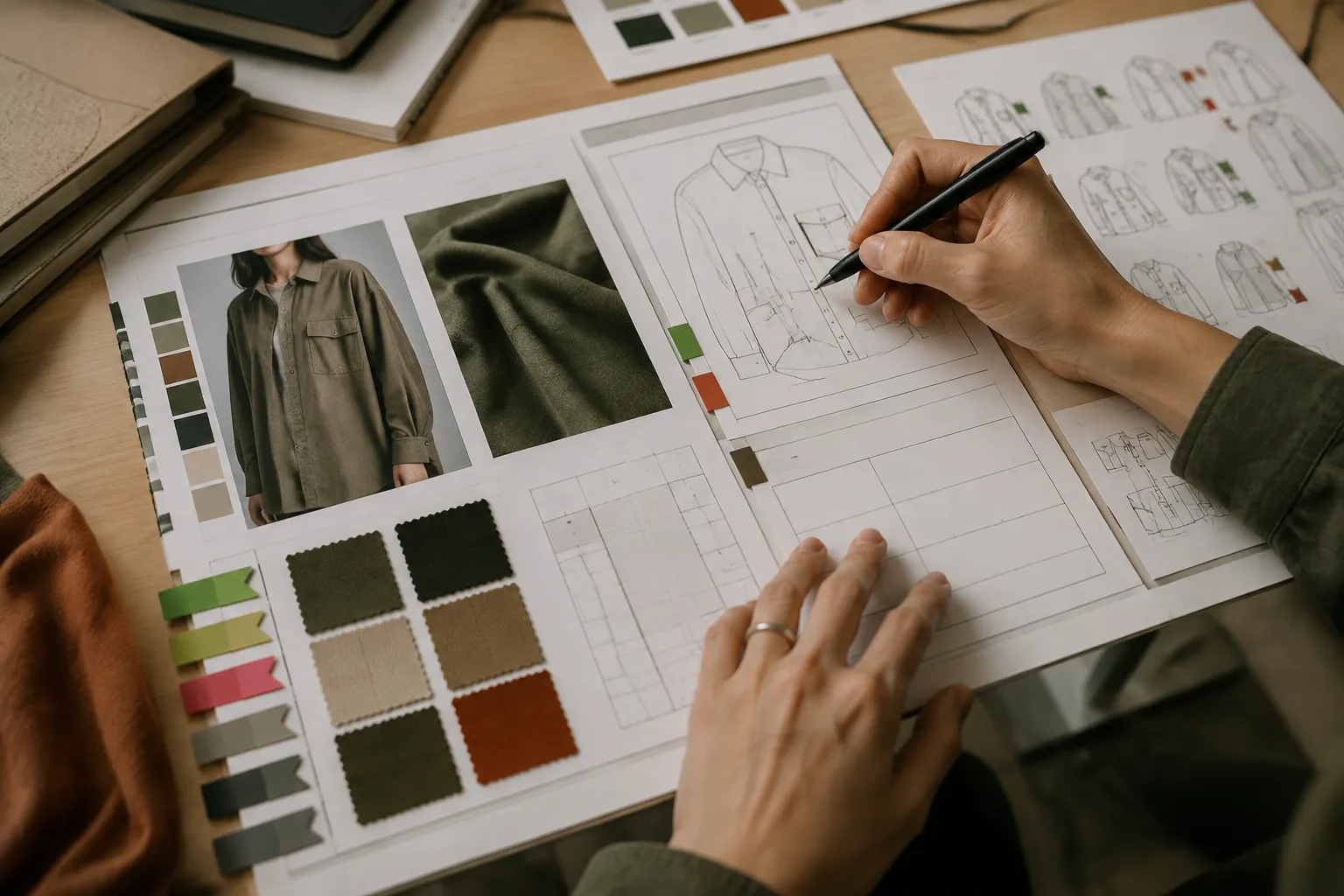
Asset type: archival garment photograph
Intended takeaway: narrow vertical proportion and restrained contrast
Permitted attributes: elongated layout, limited two-color relationship, and a small secondary mark
Excluded attributes: exact graphic, wording, emblem, and direct garment reproduction
Evidence state: observed reference; simulated application remains unconfirmed
Open question: placement and print-area limits for the selected garment
Confirmation owner: production reviewer and selected provider
The annotation preserves useful visual information without turning the source into an undocumented copying instruction.
Define Motifs Through Recurrence
A motif becomes useful when its role can be described across more than one graphic. It may recur through shape, line quality, texture, framing, spacing, color relationship, or placement.
Mark each decision as fixed, flexible, or excluded:
- Fixed: motif family, restricted color relationship, or required visual rhythm.
- Flexible: crop, scale, rotation, secondary detail, or garment-specific placement.
- Excluded: direct reproduction, unrelated visual language, or details that change the collection subject.
Consider references containing weathered paper, hand-drawn lettering, and botanical close-ups. The paper may contribute surface irregularity, the lettering uneven stroke quality, and the photographs organic contour. Their original layouts, words, and images do not need to carry forward.
Check the Direction on Intended Garments
Compare references by observable attributes rather than calling them simply right or wrong. Use the same garment range, audience context, and launch setting for each comparison.
Hierarchy and thumbnail reading
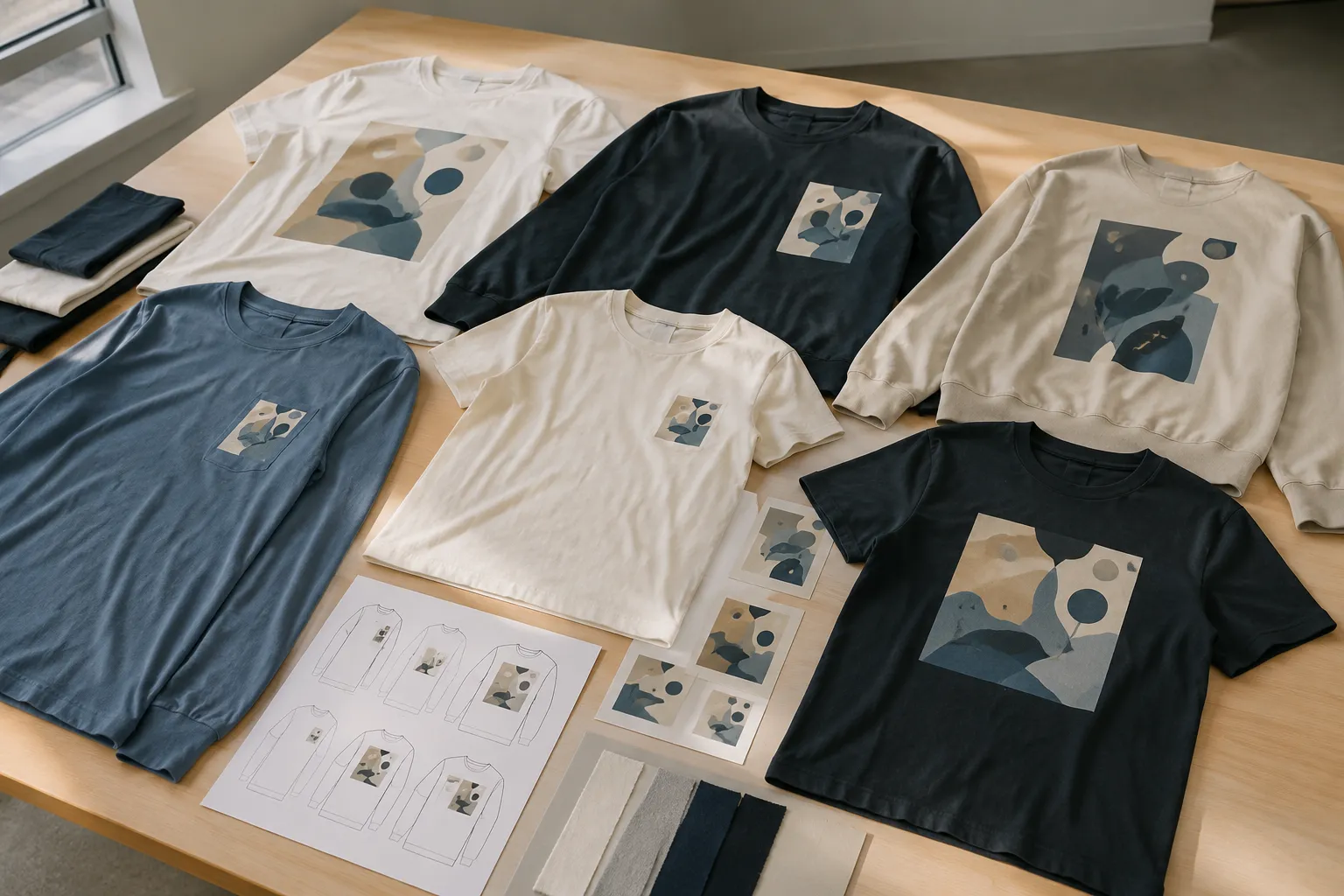
Identify what should capture attention first. A high-contrast motif may overpower the garment, while a small embedded mark may disappear in a listing frame. Record the intended order: primary graphic, secondary detail, supporting texture, then optional background element.
Color and garment tone
Keep garment tones separate from the artwork palette. A relationship that reads clearly on a light concept preview may lose contrast on a dark colorway. Mark mockup findings as simulated observations rather than production results.
Texture and typography
Check whether texture survives reduction without becoming a dark block or disappearing. For typography, record hierarchy, width, spacing, alignment, stroke character, and intended reading distance. Recognizable wording or distinctive lettering requires its own context and rights review.
Placement and silhouette
Read the graphic on the garment, not only on the artboard. Seams, collars, pockets, body shape, and print-area boundaries may interrupt the composition. Exact dimensions and supported zones depend on the current provider template for the selected product.
Audience context
Record associations that may affect how a symbol, slogan, historical reference, or culturally specific motif is read. A reference set alone cannot establish how a particular audience will interpret it.
Turn Subjective Reactions Into Checks
Early reactions are useful when they lead to an observable consequence and a specific revision.
| Reaction | Observable check | Revision route |
|---|---|---|
| The graphic feels weak. | It reads below the intended hierarchy at thumbnail size. | Adjust scale, contrast, or motif clarity. |
| The set feels disconnected. | Motif recurrence, color relationship, or visual rhythm is missing. | Restore one fixed collection attribute. |
| The placement feels awkward. | The graphic conflicts with a seam, collar, pocket, or silhouette. | Test another placement or garment context. |
| The reference is too close. | Selected attributes are not separated from source-specific details. | Add explicit permitted and excluded attributes. |
| The concept looks difficult to produce. | The brief contains visual intent but no technical handoff question. | Record the issue for production confirmation. |
The aim is not to remove judgment. It is to make the reason for that judgment usable by the next reviewer.
Know Where the Mockup Stops
A simulated mockup can help compare intended scale, placement, contrast, and collection relationship. It cannot confirm fabric interaction, physical color, print opacity, durability, placement tolerance, marketplace acceptance, or the produced result.
Move to an external confirmation point when a decision depends on:
- current provider print areas, supported files, or product templates;
- artwork resolution, seams, collars, pockets, or manufacturing tolerances;
- actual garment tone, material behavior, print texture, or opacity;
- marketplace rules, usage terms, or product-specific requirements;
- rights status for recognizable imagery, symbols, names, or wording.
Use a physical sample when the team needs to observe material, color, placement, or print behavior directly. Keep the states separate: sampled does not automatically mean approved or produced.
Keep Creative, Rights, and Production Records Separate
Reference documentation explains creative intent; it does not determine permission. Flag recognizable characters, brand identifiers, slogans, another creator's artwork, culturally specific imagery, and distinctive existing designs for the responsible rights reviewer.
Production questions need their own owner as well. Measurements, construction language, materials, labels, artwork setup, and placement limits belong in the relevant technical record. A theme direction may be approved while those details remain open.
Prepare the Handoff
End the brief with enough information for the next role to proceed without reopening the inspiration search:
- approved motif directions and original source records;
- permitted attributes and explicit exclusions;
- fixed and flexible elements;
- intended garment tones, silhouettes, placements, and colorways;
- mockup files labeled as simulated;
- physical sample status, when applicable;
- open rights, provider, production, and marketplace questions;
- an owner and next action for every unresolved item.
The record is ready for handoff when the team can state what belongs, what stays out, and how the direction should read on intended garments. Route the remaining variable to the designer, production specialist, rights reviewer, marketplace reviewer, or selected provider for confirmation.
Sources
- UNT CVAD Fashion Design Entry Review 1 Client Project Guidelines
- Fashion Design Brief: Process & Method, Objectives & Specification | IIAD
- How to write garment & product descriptions – Fashion-Incubator
- U.S. Copyright Office
- Copyright basics | USPTO
- Teaching technical specifications in fashion design education