
Garment Assortment and Product Roles
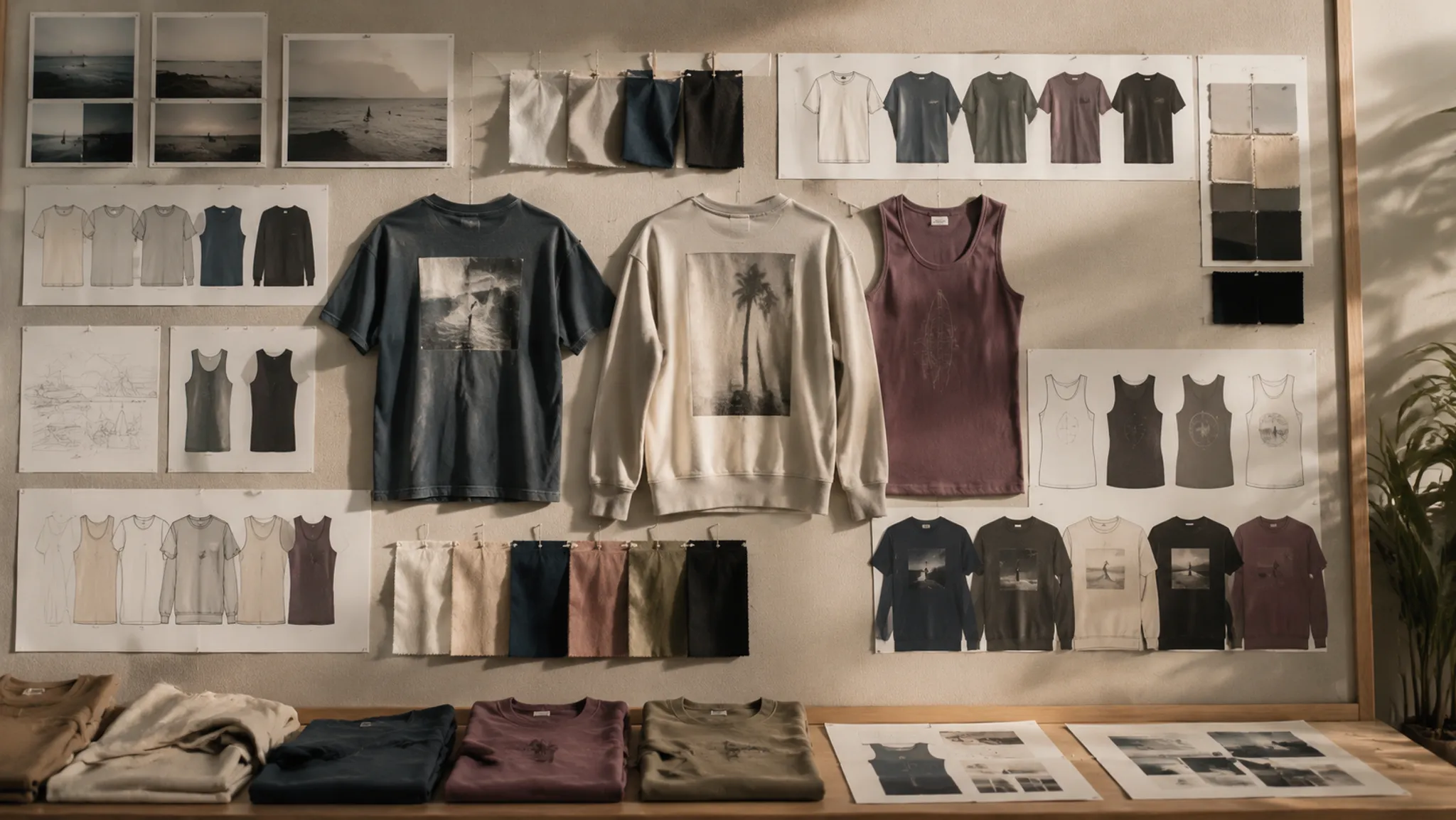
When a collection team compares garments for an apparel capsule, the decision is rarely about selecting the most noticeable piece. The team must decide which garment carries the collection's visual direction and which garments repeat, balance, or broaden it.
That is the practical role of apparel assortment planning: turning several promising garment concepts into a reviewable selection with named variables, open dependencies, and clear next checks.
Hero garment and supporting garment are useful planning labels, not universal industry categories. Define them against the collection, audience, garment range, launch context, and production route being assessed.
More specific pages
These pages continue the topic in smaller, more specific directions.
What the Assortment Decision Covers
An assortment decision connects product variety with product depth, timing, audience, budget, available information, and presentation needs. Research on apparel assortment planning commonly separates qualitative judgment from quantitative evaluation before selection and later planning.
A creative team can adapt that logic to a smaller graphic apparel collection. The comparison may include:
- Garment categories such as T-shirts, sweatshirts, tanks, or overshirts
- The number of styles and colorways
- Graphic variation across the set
- Placement across front, back, sleeve, or pocket areas
- Garment tone, silhouette, and material impression
- Audience, collection intent, and launch context
- Budget, provider constraints, availability, and size range
- Mockup requirements, listing frames, and campaign assets
- Sampling, provider confirmation, and other handoff needs
A collection can look complete while still lacking a useful role for each garment. Several attractive pieces may perform the same visual function, or added variety may weaken the relationship between the graphic set and the garment range.
Which garment should lead the collection, which garments should support it, and what evidence is needed before the selection enters the next review?
Hero and Supporting Garment Roles in an Apparel Capsule
A hero garment usually carries more of the collection's visual or narrative load. It may introduce the primary graphic language, clearest colorway, strongest placement, or most distinctive contrast.
Supporting garments help repeat, coordinate, balance, or broaden that direction. They may use a quieter graphic, a different placement, a related colorway, or another garment category that adds range without separating the pieces from the set.
These roles describe intended function. They do not predict audience response, production quality, sales, or marketplace acceptance.
| Role | Planning function | Review signal | Open dependency |
|---|---|---|---|
| Hero garment | Establishes the collection's main visual direction | Reads quickly in a collection board or listing frame | Physical appearance, provider limits, and audience response remain unconfirmed |
| Supporting garment | Repeats or balances the collection language | Relates to the hero without appearing duplicated | Coordination may change with garment tone, colorway, or print area |
| Bridge garment | Connects two visual or product groups | Helps a wider assortment feel related | The relationship may only become visible at collection level |
| Test garment | Isolates a graphic, placement, or garment variable | Shows how one change affects the collection read | A result may not transfer to every style or provider |
A hero garment does not need to be the most complex item. A simple front placement can lead when it communicates the collection more clearly than a crowded back graphic.
A supporting garment does not need to be visually plain. It may carry a different placement or colorway while preserving the same graphic set. The deciding question is whether the difference adds useful range or breaks the collection.
Variables for Comparing Garment Roles
Compare candidate garments against the same audience, collection intent, launch context, and handoff requirements. An isolated mockup can show preference, but it cannot show whether a garment performs the intended role within the complete set.
Collection Intent
State what the collection is meant to communicate. The intent may be a graphic theme, a coordinated capsule, a seasonal release, or a compact group for early comparison.
A garment that expresses the intent immediately may be a stronger hero candidate. Another may be more useful as support because it carries the theme into a different category or placement.
Record the intent in one sentence. Avoid changing the audience or campaign context during the first comparison.
Garment Tone
Garment tone describes the visible impression created by color, silhouette, material suggestion, and styling context. It affects how the graphic set is read before physical production has been confirmed.
A high-contrast tone may make a graphic read clearly in a simulated mockup. A softer tone may suit a restrained collection direction. Neither route is universally stronger.
Where possible, compare the same graphic on each candidate garment. Label the result as an observed comparison from a simulated preview, not as a physical print result.
Graphic Load
Graphic load describes how much visual attention a garment asks the collection to carry. A large back graphic, dense illustration, or prominent placement may create a stronger focal point than a small chest mark.
High graphic load can support a hero role, but it may also dominate the set. Lower graphic load can support repetition and coordination.
- Graphic scale and density
- Placement prominence
- Color contrast against the garment tone
- Relationship to adjacent garments
- Amount of explanation needed before the collection idea is clear
If every garment carries high graphic load, the collection may lose hierarchy. If every garment is quiet, the set may lack a clear lead.
Placement Relationship
Placement is both a visual variable and a later production dependency. Front, back, sleeve, pocket, and all-over concepts create different roles in listing frames and collection boards.
A front placement may communicate quickly in a product grid. A back placement may require a secondary listing frame. A sleeve or pocket placement may work as a supporting detail while remaining difficult to judge at thumbnail size.
Separate the intended placement from the provider template. A simulated mockup can show the planned location, but it cannot confirm that the artwork fits the current print area or production specification.
Colorway Structure
Colorways create useful breadth when they preserve a recognizable graphic set. They create duplication when the garment changes without adding meaningful contrast, audience relevance, or seasonal purpose.
Compare each colorway by checking:
- Whether the graphic retains enough visible contrast
- Whether the garment tone changes the collection mood
- Whether the variation adds a distinct use or audience context
- Whether it repeats an existing direction too closely
- Whether the provider offers the required garment and size range
Provider availability and size information require current confirmation. Keep those details in the source record until checked.
Handoff Effort
A garment role affects the work that follows. A hero garment may require the primary campaign asset, clearest listing frame, and first physical sample. Supporting garments may need coordinated mockups, alternate crops, and a shorter comparison pass.
A candidate that looks strong but creates unresolved handoff work may need a different role. Record that consequence instead of leaving it as an invisible production concern.
A Review Matrix for Collection Teams
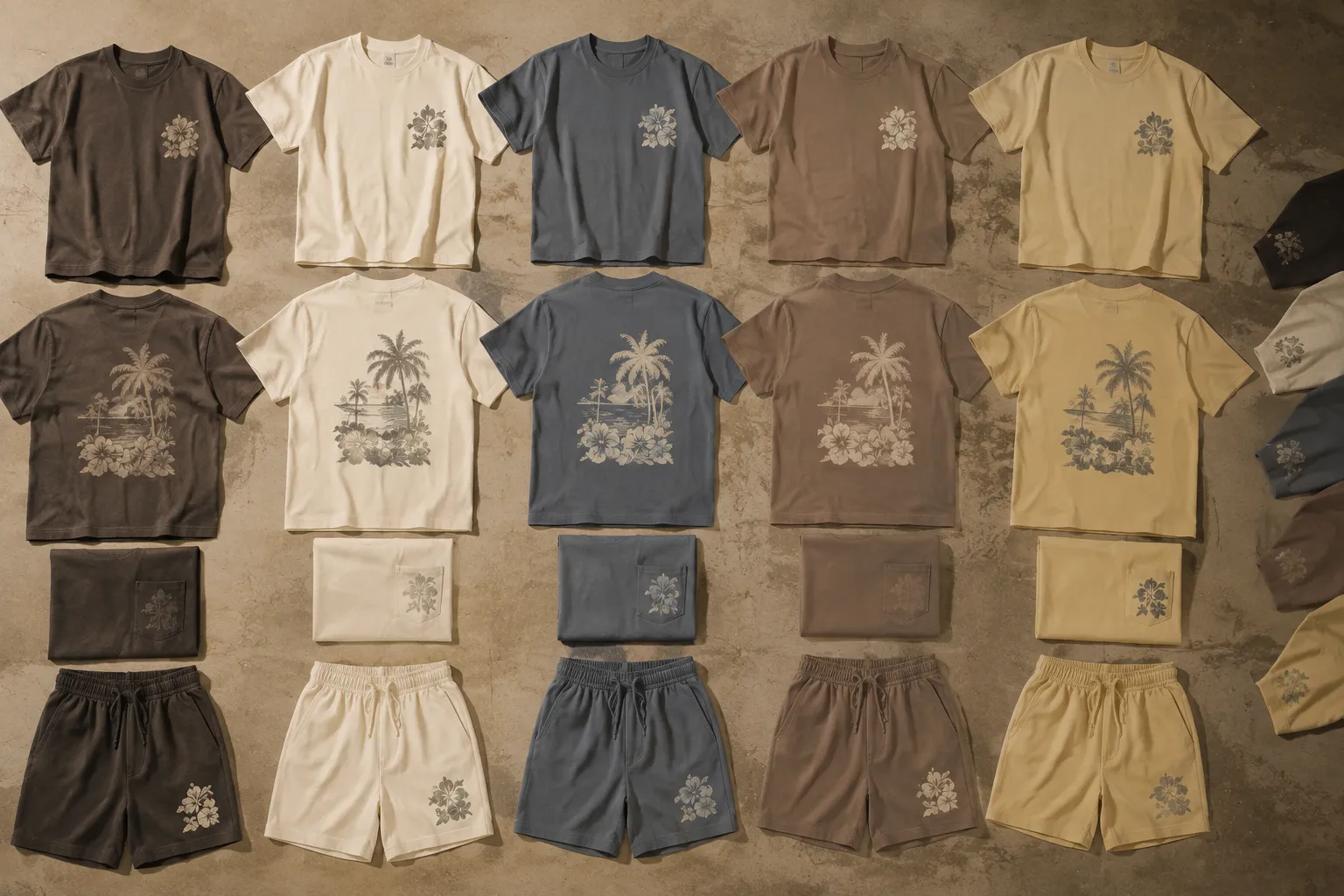
A simple matrix turns preference into a documented comparison. Use status labels such as intended, simulated, observed, sampled, approved, and produced so the evidence state remains visible.
| Variable | Candidate A | Candidate B | Candidate C |
|---|---|---|---|
| Intended role | Hero | Supporting | Supporting |
| Garment category | T-shirt | Sweatshirt | Tank |
| Garment tone | Dark neutral | Mid-tone neutral | Light neutral |
| Graphic placement | Front | Back | |
| Graphic load | High | Medium | Low |
| Collection relationship | Establishes direction | Repeats graphic language | Adds a quieter variation |
| Thumbnail read | Observed in simulated mockup | Observed in simulated mockup | Observed in simulated mockup |
| Provider template | Unconfirmed | Unconfirmed | Unconfirmed |
| Physical sample | Not sampled | Not sampled | Not sampled |
| Next action | Confirm primary sample | Check back print area | Compare contrast on sample |
The matrix does not need numerical scores. Scores can make a decision appear more precise than the available evidence. A status label with a short reason often gives another reviewer a clearer record.
If the team uses scores internally, define the scale and separate visual preference from provider or sampling confirmation.
A Practical Comparison Route
Define the collection frame. Record the audience, collection intent, launch context, garment categories, and expected handoff. Keep these conditions stable during the first comparison.
Select a small candidate group. Include garments that could realistically share the same collection. Separate garment selection from graphic invention because a new graphic changes the comparison condition.
Build a simulated comparison. Use matching listing frames or collection-board crops. Keep scale, background treatment, placement, and presentation context consistent. Label the result as a simulated mockup or concept preview.
Read the set at two scales. At collection scale, check coherence and hierarchy. At thumbnail size, check whether the hero still leads and whether supporting pieces remain distinguishable.
Test the role assignment. Remove the proposed hero from the board and check whether the supporting garments still relate. This reveals whether the set has a repeatable graphic structure or depends on one asset.
Mark unresolved external inputs. List provider specifications, print-area dimensions, availability, fabric differences, physical color, manufacturing limits, marketplace guidance, and rights permissions that remain open.
Choose a route and record the reason. The team may retain one hero, use several equal-weight garments, assign different heroes to separate campaign contexts, hold a test garment for sampling, or reduce the assortment pending provider confirmation.
The route depends on the collection frame and the evidence available. The useful outcome is a decision record that another reviewer can interpret.
Common Mix-Ups
A Hero Garment Is Not Automatically the Most Detailed
Detail can attract attention, but collection leadership also depends on clarity, garment tone, placement, and context. A complex graphic may become difficult to read in a listing frame.
Reconsider the role when the candidate needs explanation before the collection intent is visible.
A Supporting Garment Is Not a Weaker Version
Support can mean coordination, contrast, repetition, or range. A supporting garment may be essential even when it carries less graphic weight.
Remove it only when its function is duplicated or its difference breaks the set.
A Mockup Is Not a Physical Sample
A mockup supports comparison of scale, placement, garment tone, and listing presentation. It cannot confirm how fabric, ink, color, construction, or manufacturing variation will appear.
When the decision depends on those factors, request a physical sample or direct confirmation from the relevant provider.
More Variety Is Not Automatically a Stronger Assortment
Breadth may address different garment preferences or contexts. Excess variety can weaken the graphic relationship and increase unresolved variables.
Compare every added garment against a specific function. If the team cannot name its role, keep it in a separate exploration group.
Research Models Do Not Settle Creative Role Names
Research on apparel assortment planning discusses inputs such as breadth, depth, target market, timing, budget, inventory, and product selection. It does not establish hero garment and supporting garment as universal categories.
Use those terms as an internal planning framework. Define them in the brief so another reviewer can interpret the choice consistently.
When the Mockup Stops Being Enough
A simulated preview can support early comparison of relative graphic scale, placement hierarchy, garment-tone contrast, collection-board rhythm, listing-frame consistency, colorway relationships, and visual duplication.
It becomes insufficient when the decision depends on exact print-area boundaries, current provider templates, fabric behavior, physical color, construction or fit, manufacturing constraints, rights permission, marketplace requirements, or final production status.
Keep those confirmation points separate in the source record. A useful handoff includes the preview, intended role, garment and artwork variables, unresolved questions, and the responsible source or reviewer.
Worked Example: A Three-Garment Graphic Set
Suppose a team is preparing a compact graphic collection for a seasonal launch. It compares a dark neutral T-shirt with a large front graphic, a mid-tone sweatshirt with a smaller back graphic, and a light neutral tank with pocket placement.
The T-shirt may receive the hero role because its intended scale and placement introduce the collection direction quickly. The sweatshirt may support the set by repeating the graphic language in another garment context. The tank may add range through a lighter tone and quieter placement.
That assignment remains provisional. The team should record:
- Audience and launch context
- Intended role for each garment
- Graphic set and version number
- Garment tone and colorway
- Placement and intended print area
- Simulated preview status
- Thumbnail observation
- Provider confirmation status
- Sampling status
- Rights-review status
- Next revision or handoff
If the tank loses contrast in the simulated preview, the next action may be to revise the graphic colorway or reassess its role. If the sweatshirt sits outside the current provider template, confirm that template before treating the garment as an approved selection.
The failure does not settle the garment's suitability. It identifies the next decision.
Recording Assortment Decision Variables
A reviewable record should make the choice understandable without relying on memory. Keep preference, observation, and external confirmation visibly distinct.
| Record field | Example status |
|---|---|
| Collection intent | Intended |
| Role assignment | Team preference |
| Graphic relationship | Observed comparison |
| Mockup appearance | Simulated |
| Placement dimensions | Provider information required |
| Garment availability | Provider information required |
| Print and color result | Physical sample required |
| Rights and usage | Separate rights review |
| Marketplace presentation | Current marketplace guidance required |
| Final selection | Approved only after responsible review |
Preserve rejected or deferred candidates when they explain the decision. A deferred garment may become relevant under another launch context, colorway, or provider route.
Describe a produced result only after production has been confirmed. A simulated result remains a simulated result.
Compact Approval Gate
- Is the collection intent written clearly?
- Does each garment have a named role?
- Can the team explain what changes between hero and supporting garments?
- Were candidates compared against the same audience and launch context?
- Are graphic scale, placement, garment tone, and colorway recorded?
- Is each visual observation labeled as simulated or sampled?
- Are provider specifications and print areas marked unconfirmed where necessary?
- Are rights, usage permissions, and marketplace guidance handled separately?
- Does every selected garment have a documented next handoff?
- Can another reviewer understand why the current assortment was chosen?
A complete checklist does not establish production readiness. It shows that the assortment decision is organized enough for the next review.
Next Handoff
Apparel assortment planning reaches a useful stopping point when the team has a documented choice and a visible list of unresolved dependencies. The next stage may concern graphic refinement, placement files, provider templates, physical sampling, listing visuals, rights review, marketplace guidance, or production confirmation.
Carry the same variables forward. Keep intended, simulated, observed, sampled, approved, and produced states separate so the next reviewer can identify what has been decided and what still requires confirmation.

Sources
- Developing an Assortment Planning Process Model for Clothing Retail Buyers: An Exploratory Research
- Assortment planning in fashion retailing: methodology, application and analysis
- Retail buyer segmentation based on the use of assortment decision factors
- Development of an Assortment Planning Model for Fashion Sensitive Products
- Toward a Model of Retail Product Development: A Case Study Analysis
- Using the analytic hierarchy process for selecting prototypes in the development process of fashion garment products
- Apparel Retail Product Development: Model Testing and Expansion