Apparel Graphic Variation Matrix for a Coordinated Collection
An apparel graphic variation matrix works when every option is compared against the same garment set, placement logic, garment tone, audience context, and launch asset. It separates three states:
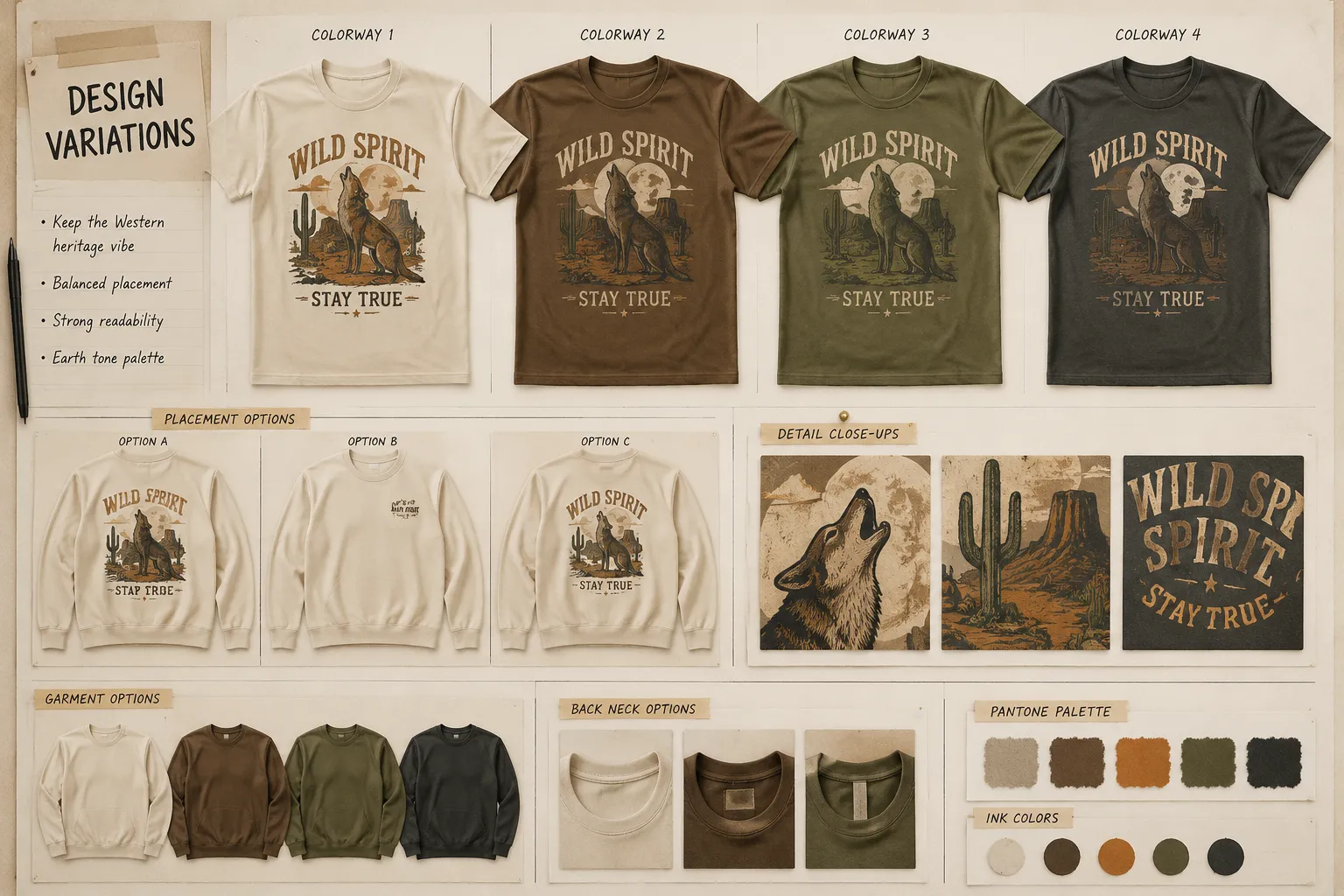
- What the team can observe in a concept preview or simulated mockup
- What requires a physical sample or swatch review
- What still needs provider, rights, or marketplace confirmation
The matrix is a graphic variation decision record. It helps the team keep, revise, defer, or remove each direction without losing the reason behind the decision. It is not a production proof.
Fix the Comparison Set First
Do not compare one variation on a dark shirt, another on a light shirt, and a third in a different listing frame. The changed conditions can decide the reaction before the graphic itself has been assessed.
| Comparison input | Record before reviewing variations |
|---|---|
| Garment set | Styles, garment tones, and available sizes under consideration |
| Graphic set | Shared motif, text system, illustration family, or collection identifier |
| Placement | Front, back, sleeve, pocket area, or another intended print area |
| Colorway | Artwork colors and garment tones assigned to each variation |
| Audience context | Intended wearer, use occasion, niche, or collection theme |
| Launch asset | Listing frame, detail crop, campaign asset, or internal review image |
| Asset status | Intended, simulated, observed, sampled, approved, or produced |
A fixed frame makes visible differences easier to discuss. It also exposes when a favorable crop, brighter garment tone, or larger graphic is influencing the result.
Compare the Same Variables Across Every Direction
Design appeal alone does not explain why a variation belongs in a coordinated collection. Use criteria the team can inspect now or verify at a later stage.
| Criterion | Visible check in a simulated mockup | Later confirmation |
|---|---|---|
| Collection relationship | Shared visual language, motif, type treatment, or proportion | Whether the complete set remains consistent after production |
| Thumbnail reading | Main shape, text hierarchy, and contrast at listing size | How the produced decoration reads under actual viewing conditions |
| Garment interaction | Artwork contrast, placement balance, and garment-tone relationship | Actual fabric color, surface, texture, and decoration behavior |
| Placement control | Alignment with seams, neckline, pocket area, or body center | Provider print-area limits and placement tolerances |
| Colorway logic | Clear differences between colorways without breaking the set | Final color appearance on the selected garment and process |
| Asset consistency | Agreement between mockup, detail crop, and campaign frame | Whether produced items match the approved presentation |
| Revision effort | Number and scale of visible changes needed before handoff | Provider adjustments, sampling cycles, or material changes |
These are team criteria, not universal apparel rules. A restrained collection may prioritize proportion and garment tone. A text-led set may give more weight to legibility and placement.
Make Each Row a Complete Variation
One row should represent one garment, graphic treatment, placement, colorway, and launch context. An isolated artwork file leaves too many conditions unstated.
| Variation ID | Garment | Placement | Colorway | Mockup observation | Next evidence | Decision |
|---|---|---|---|---|---|---|
| A01 | Garment 1 | Front center | Colorway 1 | Reads clearly at thumbnail size | Sample surface and color; confirm print area | Keep pending review |
| A02 | Garment 1 | Front center | Colorway 2 | Loses contrast on the garment | Check decoration result and provider process | Revise |
| A03 | Garment 2 | Pocket area | Colorway 1 | Feels balanced in the listing frame | Check scale and pocket-area limits | Defer |
| A04 | Garment 3 | Back graphic | Colorway 3 | Works as a collection anchor | Confirm garment template and listing details | Keep pending confirmation |
These observations are illustrative team notes. They are not physical print results or provider requirements. Replace general reactions with visible details: “the secondary line disappears at thumbnail size” preserves more decision value than “looks better.”
Separate Preview, Sample, and Provider Evidence
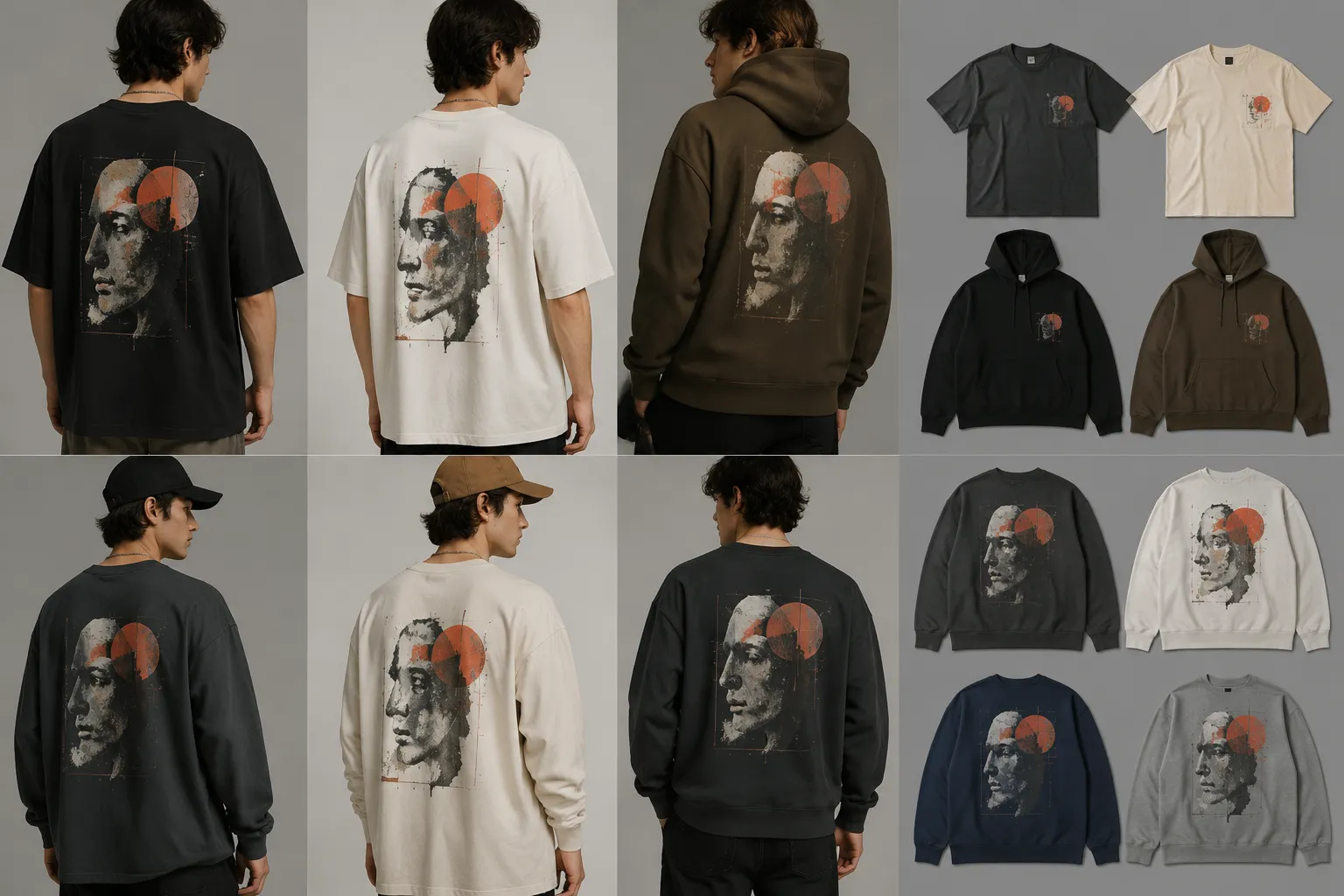
A common misunderstanding is treating a simulated apparel graphic mockup as evidence for every later stage. Label the asset in the file name, matrix, and meeting record.
Concept Preview
A concept preview communicates intended direction. It supports comparison of graphic hierarchy, relative scale, placement relationships, garment-tone contrast, collection rhythm, and listing-frame consistency.
It does not establish final color, fabric interaction, production tolerance, rights status, marketplace acceptance, or sales performance.
Physical Sample
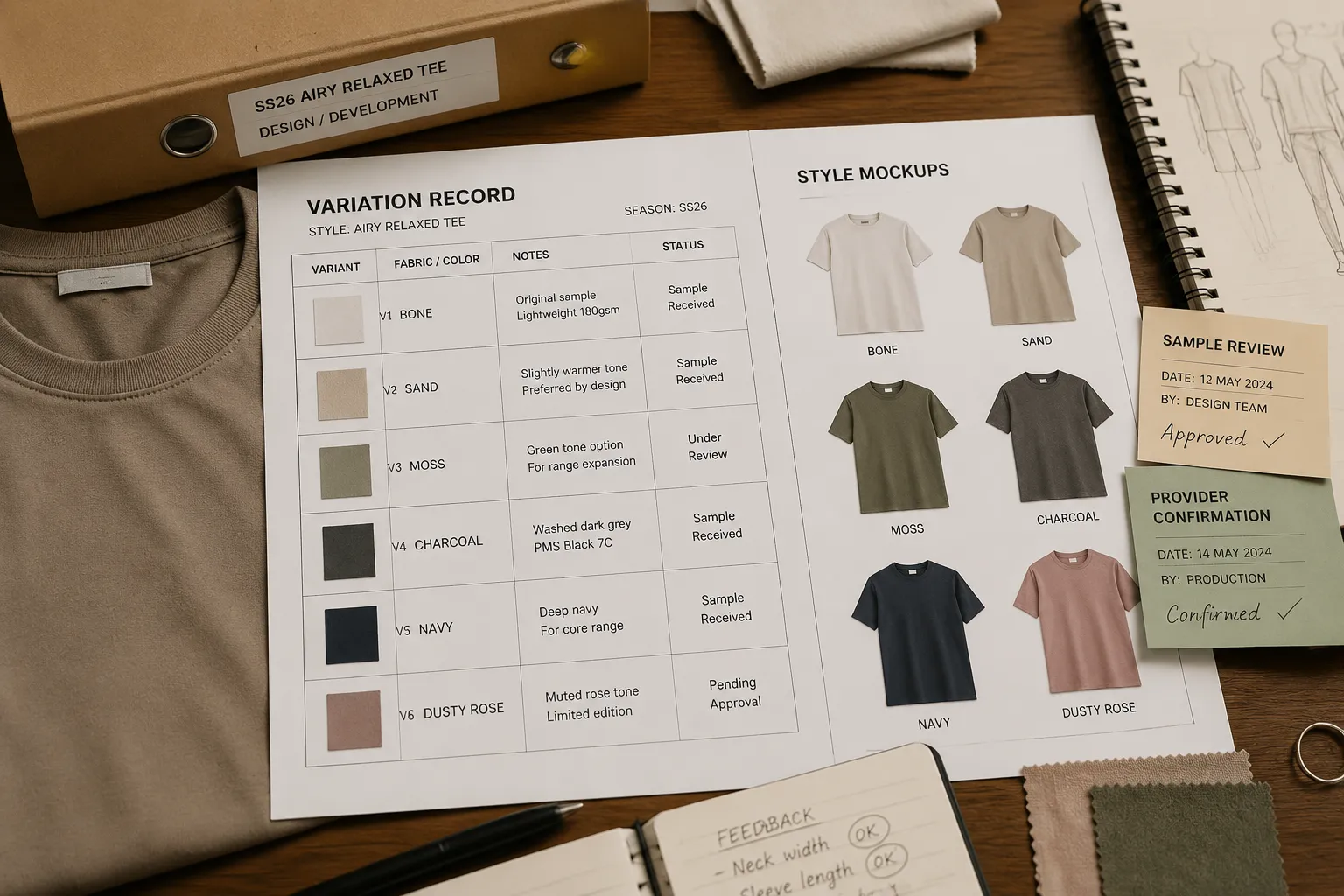
A physical sample or swatch provides different evidence because the team can inspect the selected material and decoration result together. Record the sample separately:
- Sample ID, garment style, and garment tone
- Graphic version and placement
- Decoration or print process, if confirmed
- Date received
- Visible observations and open uncertainties
- Decision after the sample review
A shared record may be sufficient when it preserves the status, observation, and responsible next action. The sample-management literature supports tracking these transitions; it does not require a particular tracking technology.
Provider Confirmation
Provider confirmation covers questions that a mockup and sample may not settle:
- Which template applies to the garment and placement?
- What print-area or placement limits apply?
- Which artwork file specifications are required?
- How are color values handled in the selected process?
- Are there restrictions around seams, pockets, labels, or other garment features?
- Which variants are available for the intended garment set?
- What details remain subject to production review?
Record the provider, documentation version or access date, exact question, response, and affected variation. A template from one provider is not a universal requirement for another.
Run Four Focused Review Passes
1. Family Relationship
Place all variations together at the same display size. Check motif language, type hierarchy, line weight, graphic density, garment position, and the relationship between primary and secondary graphics.
Then identify what is meant to change: accent color, crop, text detail, placement, garment tone, or scale. When too many variables change at once, the team cannot tell whether the set is coordinated or merely varied.
2. Thumbnail Reading
Reduce the listing frame or collection board to its intended viewing size. Record the first visible signal:
- Main graphic remains identifiable
- Small text loses hierarchy
- Accent color disappears against the garment
- Back placement is hidden in the primary frame
- One variation draws attention away from the collection
This pass informs presentation decisions. It does not show that a produced garment will read identically.
3. Garment Tone and Placement
Compare each graphic on its assigned garment tone. Inspect artwork contrast, distance from seams and pockets, apparent scale across garment styles, front-to-back balance, and fit within the intended listing frame.
When a placement appears close to a boundary, mark it for provider confirmation. Do not settle a template question through visual judgment alone.
4. Launch Asset Consistency
Review the simulated mockup beside the proposed listing frame, detail crop, and campaign asset. Look for different apparent scales, mismatched colorway labels, crops that hide placement limitations, unavailable garment variants, or imagery that implies a sampled or produced state.
Use “simulated mockup” or “illustrative preview” when the garment has not been sampled.
Use Scoring as a Team Record
A team may score each direction from one to five for collection relationship, thumbnail readability, garment-tone contrast, placement clarity, launch-asset consistency, and revision effort. Keep the scoring method visible as a team preference.
Add a status such as Keep, Revise, Defer pending sample, Defer pending provider confirmation, or Remove from this collection. Do not let a total score hide a blocking issue. A visually appealing direction may still need confirmation when its placement sits outside the available template.
Scoring exposes decision logic. It does not predict sales, marketplace acceptance, or final production quality.
When the Mockup Stops Being Enough
Move to a physical sample when surface, color interaction, actual garment construction, fine detail, small text, or two visually similar directions could change the decision.
Move to provider confirmation when the print area, garment support, artwork specification, color handling, template, policy, or product detail is unclear or may have changed.
Move to current marketplace documentation or a rights review when the listing depends on a platform rule, third-party material, recognizable reference, usage permission, or platform-specific wording and imagery review.
Preserve the unresolved state. “Pending confirmation” is more useful than an unsupported approval label.
Compact Review Workflow
- Freeze the garment set, graphic set, placements, colorways, audience context, and launch frame.
- Assign a unique variation ID to every complete direction.
- Label each asset as intended, simulated, observed, sampled, approved, or produced.
- Check family relationship, thumbnail reading, garment interaction, placement, and launch-asset consistency.
- Record one visible observation and its consequence for each variation.
- Mark the next evidence stage: sample, provider confirmation, marketplace documentation, rights review, or revision.
- Record the decision owner and exact unresolved question.
- Carry the matrix and source files into the next handoff.
The useful output is not the ranking alone. It is the decision, reason, evidence stage, and next owner together.
Handoff Record
Use a separate handoff block for any direction that cannot be decided from the current mockup review.
| Field | Handoff entry |
|---|---|
| Collection name | Working collection identifier |
| Variation ID | Exact row from the matrix |
| Current state | Intended, simulated, observed, sampled, approved, or produced |
| Decision | Keep, revise, defer, or remove |
| Visible reason | Specific observation from the review pass |
| Required evidence | Physical sample, provider response, marketplace documentation, or rights review |
| Exact question | One question that can receive a clear answer |
| Responsible owner | Person or role assigned to obtain confirmation |
| Source record | File, template, message, or document to retain |
| Next review point | Condition that returns the variation to review |
| Date checked | Date for details that may change |
Avoid “confirm everything.” Write the precise uncertainty, such as whether a pocket-area placement is supported or whether the selected garment is available in the intended colorway.
Common Misunderstandings
A polished mockup is treated as a proof
A simulated mockup communicates scale and placement. It does not establish the produced result. Route material, color, and manufacturing questions to sampling or provider confirmation.
A coordinated colorway is treated as a confirmed color result
The matrix compares intended color relationships. Final appearance depends on inputs that may not be visible in the preview, so keep colorway selection separate from final color confirmation.
A high score is treated as a market result
A team score records internal preference against selected criteria. It does not establish customer demand, marketplace acceptance, or commercial performance.
One listing frame represents the whole collection
A front-facing frame may hide back graphics, pocket placements, or scale differences. Use the asset a customer will actually see, then retain detail views for internal comparison.
Decision Rule
Keep a direction when its role in the collection is clear, its visible issues are recorded, and no unresolved constraint blocks the next stage.
Revise it when the mockup exposes a specific problem such as lost hierarchy, weak contrast, inconsistent scale, or a broken collection relationship.
Defer it when the decision depends on a physical sample, provider template, current marketplace documentation, or rights review.
The completed matrix should leave the next reviewer with four clear answers: what changed, what was observed, what remains unconfirmed, and who must resolve it.
Sources
- The role of standardized technical packages in ensuring consistency and accuracy in apparel product development
- Using the analytic hierarchy process for selecting prototypes in the development process of fashion garment products
- A RFID-case-based sample management system for fashion product development